The Evolution of Water Costs in Johannesburg
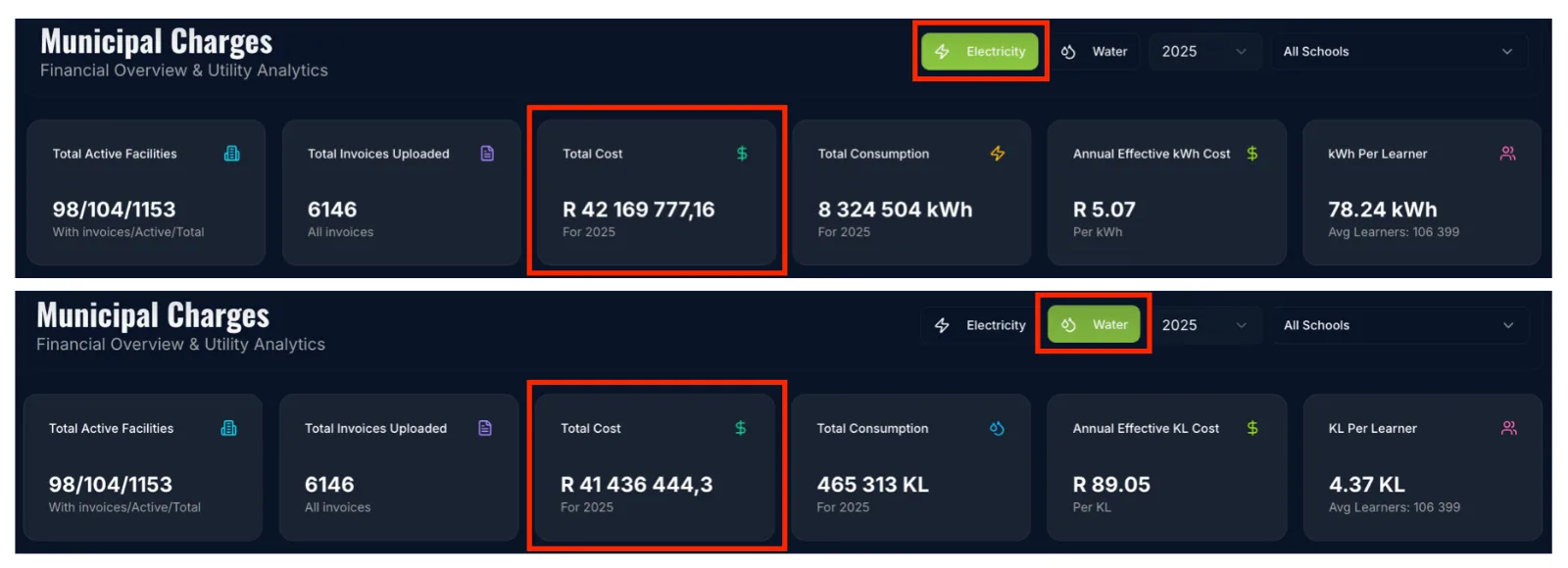
The Evolution of Water Costs in Johannesburg. As schools across Johannesburg grapple with mounting utility budgets, establishing a clear baseline requires understanding one fundamental metric: the Effective Average Cost per Kilolitre (KL).
 Ken Nunes 7 November 2026 2 min read
The Evolution of Water Costs in Johannesburg.
As schools across Johannesburg grapple with mounting utility budgets, establishing a clear baseline requires understanding one fundamental metric: the Effective Average Cost per Kilolitre (KL).
By dividing a school's total monthly municipal bill (including basic supply charges, sewer charges, ancillary fees, and VAT) by the total volume of water consumed (KL), we determine the true operational cost of water.
Water pricing is not complex, but managing it is a marathon, not a sprint. The more a school consumes—or loses to undetected after-hours leaks—the higher its effective rate scales. The primary governance objective must therefore be identifying operational waste and embedding data-driven efficiency into campus management.
Analysing the 14-Year Trend (2012 to 2026)
Studying historical tariff increases highlights why investing in aging school plumbing infrastructure is the single most effective strategy to preserve school budgets.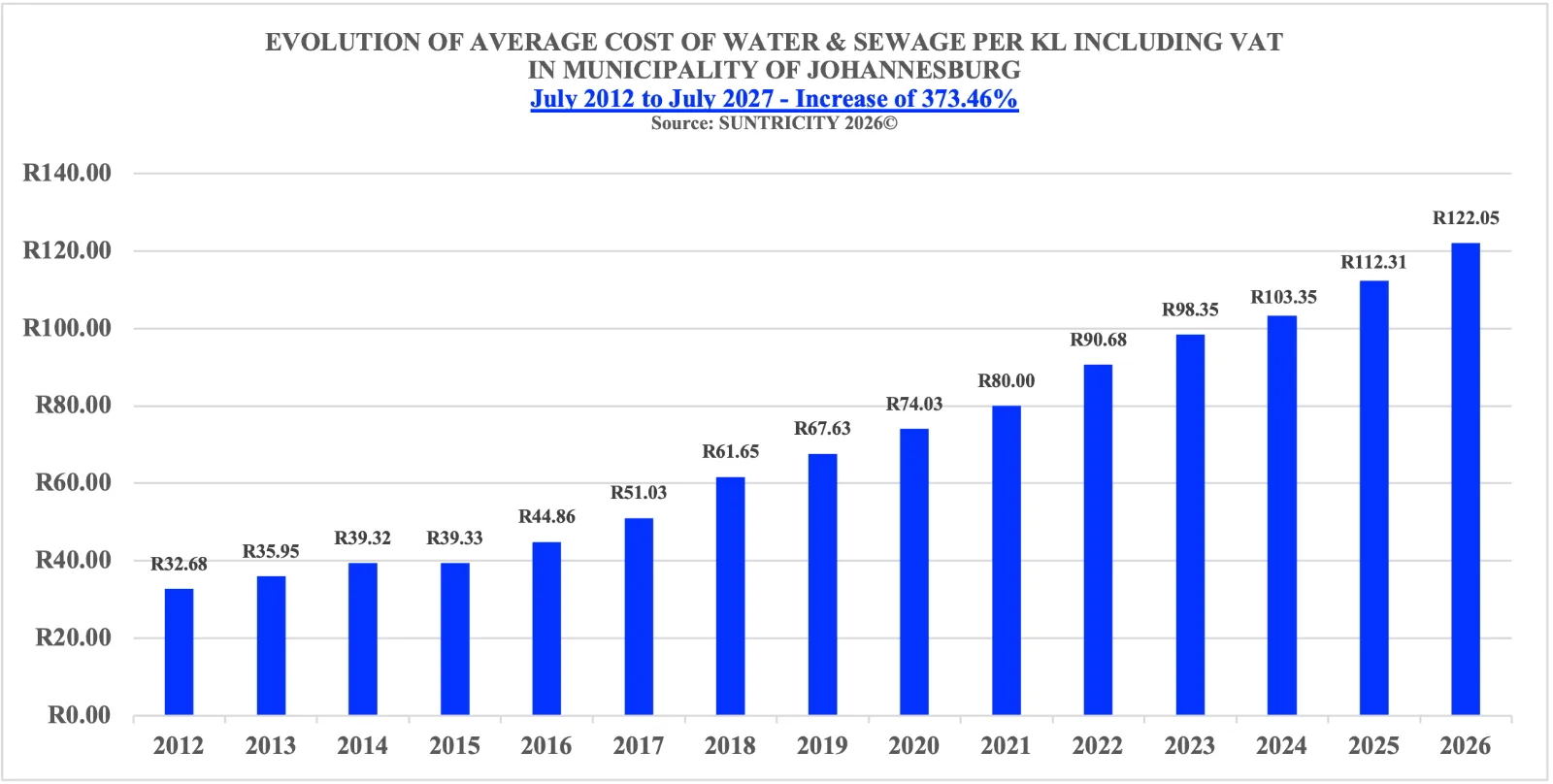
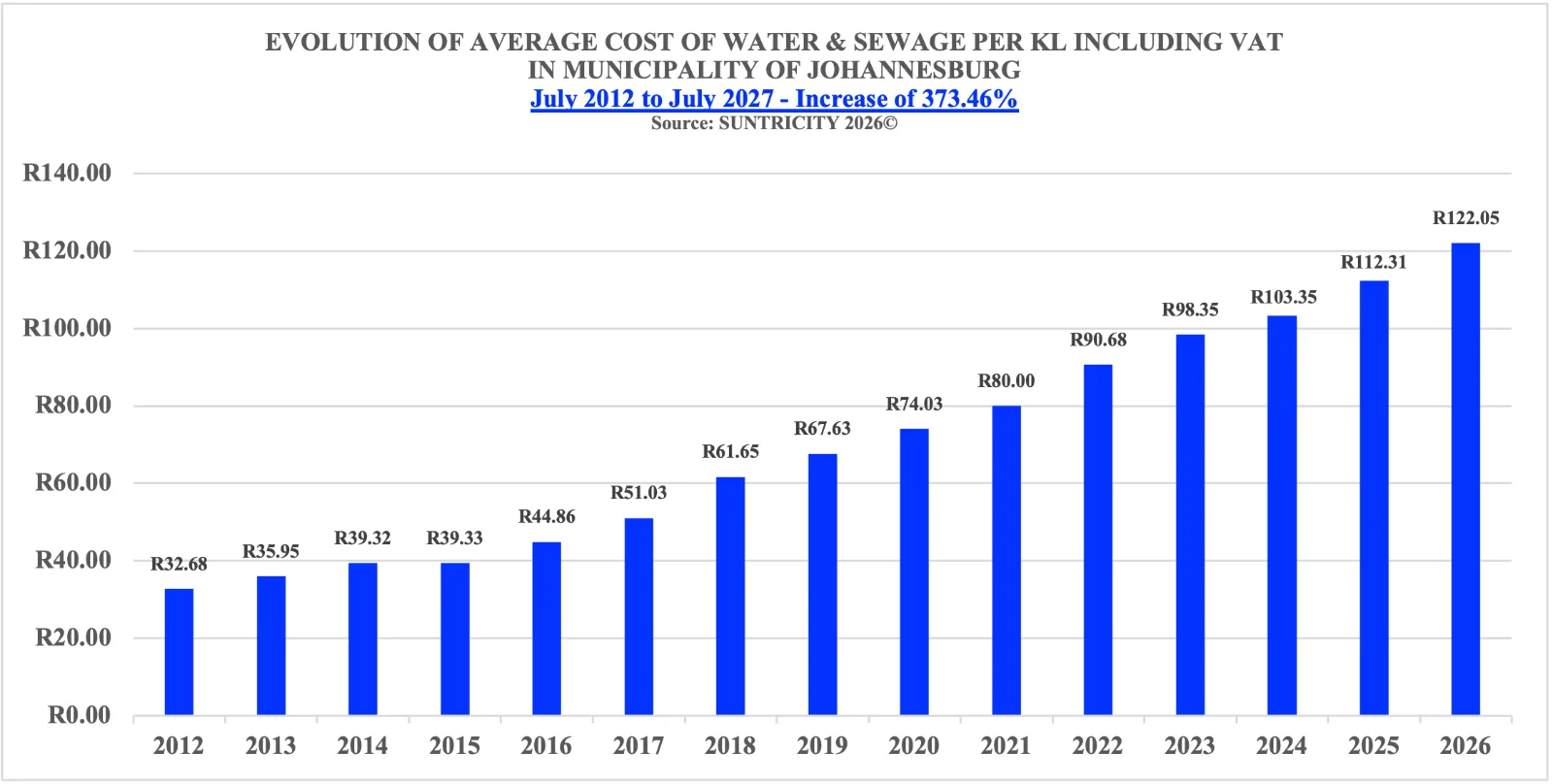
Between 2012 and 2026, the effective average cost of water and sanitation in Johannesburg surged from R32.68 per kL to R122.05 per kL—reaching a staggering 373.5% of its original 2012 cost baseline.
Schools are now paying nearly 3.75 times more for every single drop of water consumed compared to fourteen years ago.
The 10-Year Outlook: Projecting Costs to 2036
If municipal water tariffs continue on this trajectory over the next decade, schools will face an average cost of approximately R275.00 to R312.00 per KL by 2035/2036.
To put this in perspective for an average primary school consuming 4,500 KL annually
Strategic Governance for 2027
Administrators and School Governing Bodies (SGBs) cannot hide from this reality. Utility tariffs will continue to rise, and the only variable within a school's control is volume of water being consumed.
Previous studies by Suntricity between 2017 and 2020 (see AquaStop™ Case Study) proved that between 41% and 72% of school water consumption occurring outside school hours. Eliminating waste is therefore an imperative through planned maintenance, leaking cistern, dripping taps, undetected underground burst pipes, must be part of the agenda for 2027.
Many forward-thinking schools have already implemented continuous water tracking to protect their budgets (See this blog). As we prepare for 2027, establishing your baseline and tracking your effective water cost is the first step toward long-term financial stewardship.
Was this article helpful?