AQUASTOP™ A SELECTION OF CASE STUDY TO 2022
AQUASTOP™ A SELECTION OF CASE STUDY TO 2022. BACKGROUND AND CHALLENGES. Since 2016, Suntricity has meticulously monitored and tracked electricity and water consumption in schools, predominantly in Johannesburg. Our approach involves a comprehensive analysis of municipal invoices to evaluate all aspects of kWh and KL usage, alongside the ancillary costs and tariff regimes imposed by the municipali
 Ken Nunes 7 November 2026 4 min read
Since 2016, Suntricity has meticulously monitored and tracked electricity and water consumption in schools, predominantly in Johannesburg. Our approach involves a comprehensive analysis of municipal invoices to evaluate all aspects of kWh and KL usage, alongside the ancillary costs and tariff regimes imposed by the municipality. While electricity is generally considered the primary financial burden on schools, it was soon soon realised that water costs posed a greater threat. Driven by sharp price increases and escalating environmental concerns—notably Cape Town’s Day Zero in 2018—water quickly became the primary focus.
Suntricity carried out real-time monitoring at 10 schools in Johannesburg, where “check meters” were installed, monitoring consumption on a 24/7/365 basis.
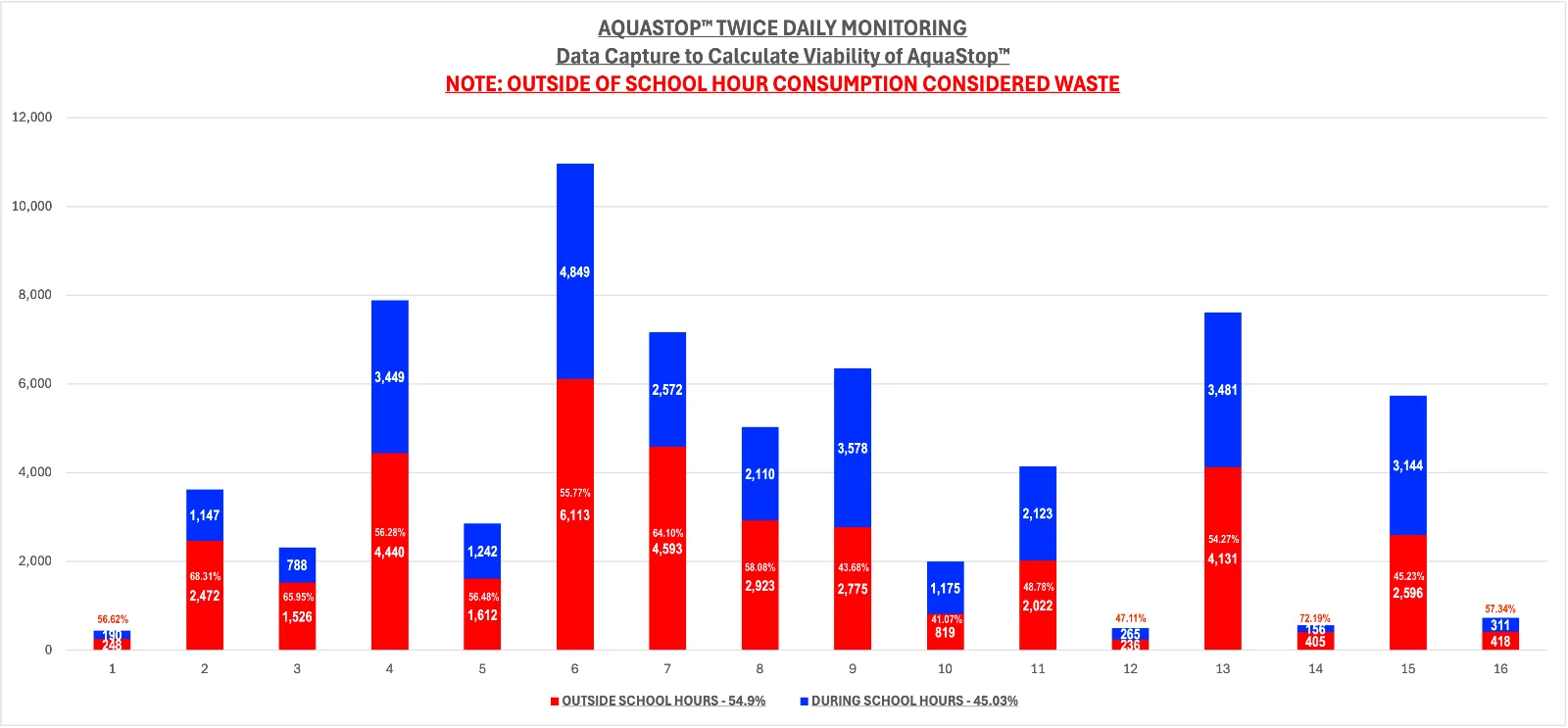
It was discovered that in all cases water consumption between 6PM and 6AM i.e. OUTSIDE SCHOOL HOURS was between a low of 38% and a high of 72% of total consumption.
This outside of school hours loss was predominantly the result of inadequate maintenance, principally in toilet facilities, where very common and practically unnoticeable cistern leaks would result in a loss of 2 Litres per minute, 120 Litres each hour, 2,880 Litres each day and 86,000 Litres each month. With the average school providing facilities for 1,000 Learners, schools have between 20 and 30 toilets and similar numbers of sinks and taps.
During the study period, it was quite common that as many as 6 of these “small leaking cisterns”, dripping taps and even more serious cistern issues were found, going unnoticed and un-reported and un-repaired for days and even weeks.
Where in times gone by, this waste may well have gone unnoticed, the increase in water tariffs between 2012 and 2025, together with growing awareness of the environmental consequences of wasting water, ensured that school now pay serious attention.
Based on an extensive 2025 study by Suntricity of 62 Johannesburg primary schools, the average monthly water consumption was 470 KL. In 2012, this volume of water would have cost R15,360. However, by 2025, the cost for the exact same 470 KL has increased by a staggering 343%, driving the monthly expense up to R52,654. To mitigate the impact of these dramatic cost escalations, a complete shift in mindset is essential for schools throughout South Africa.
SOME BASIC FACTS
Schools are operational between 6AM & 6PM (12-hours). The other 12-hours they are essentially empty.
The average school year is 200 days, therefore for 165 days the school is closed.
There are 8,760 hours per year (365x24). Therefore, for 2,400-Hours (200x12) the school is operational and 6,360-Hours Non-Operational - 30% Operational and 70% Non-Operational.
It is of course appreciated that schools will have many events outside of these basic times during the course of the year, together with a variety of nocturnal usages, even staff living on site, which would influence the numbers. However, the vast majority of these events will involve a small number of people and water usage should be limited and certainly should not be responsible for between 40% to 60% of total consumption.
This extensive research and even further countless hours of discussions, we concluded that in order to eliminate waste consumption outside of school hours, we needed a solution that would TURN WATER OFF for the maximum period of the 6,360 non-operational hours.
This, in a nutshell, led to the development of AQUASTOP™.
AQUASTOP™ DEVELOPMENT
The development of the solution to respond to these inherent water waste issues, was carried out in stages, where initially a basic test functionality was designed, built and installed at the collaborating Pilot School Northcliff Primary, to test the functionality under real conditions.
AquaStop™ introduces a shut off electronic valve to the main incoming water pipe, which can be controlled via Suntricity’s proprietary Online Application, giving schools total control of operation to set ON/OFF times to suit their specific needs, with over-ride functionality when events take place outside the programmed times and where authorised personnel have secure access.
The design intention was therefore to provide:
- Ease of operation
- Set parameters to suit the needs of each individual school
- Utilise mobile and cloud technology, operate by smart phone, tablets, or computers
- Secure access and adequate firewalls
- Maximise AquaStop™ closure during evening, weekends and holidays
- Provide no noticeable change to water service quality at the school
- Maximum Elimination of waste
Since the initial development in 2017, AquaStop™ has had three distinct operational improvements to the technology controlling AquaStop™, with AquaStop™ MK3 introduced in 2022.
Improved operation and control, simpler and more reliable communication set up, lower costs implementation, as well as additional features, (including the addition of a main stop valve and a filter) are all part of the on-going improvements made to AquaStop™ over the intervening years.
The results have been nothing short of phenomenal and we are extremely proud to present this very South African initiative, conceived and developed in Joburg. The following pages presents a small part of the successes achieved at some of the initial installations between 2017 and 2022.
For a full copy of the Case Study, drop us an email...it will be a pleasure to send it to you.
Was this article helpful?