Backcasting for Schools
Working Backward from a Vision of Excellence. When School Governing Bodies (SGBs) and financial committees plan their long-term budgets, they almost universally rely on forecasting: looking at last year's utility bills, adding an estimated 8% or 10% for municipal tariff increases, and finding ways to absorb the cost.
 Ken Nunes 8 November 2026 3 min read
Working Backward from a Vision of Excellence.
When School Governing Bodies (SGBs) and finance committees plan their long-term budgets, they traditionally rely on forecasting: reviewing previous utility expenditure, adding an estimated percentage for municipal tariff adjustments, and managing the resulting costs.
While traditional forecasting focuses on managing incremental changes, adopting a forward-thinking strategic model creates new possibilities: Backcasting.
What is Backcasting?
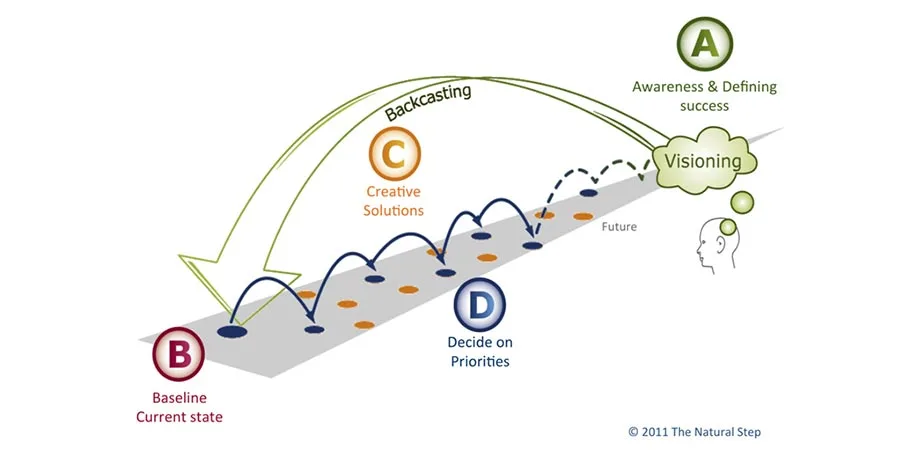
Coined by The Natural Step, backcasting is a planning methodology designed for strategic progress:
"The concept of backcasting is central to a strategic approach for sustainable development. It is a way of planning in which a successful outcome is imagined in the future, followed by the question: What do we need to do today to reach that successful outcome? This approach inspires creative solutions and opens up a wide range of opportunities for positive change."
Instead of asking "How much will municipal utilities cost us next year?", backcasting asks: "What does an optimized, highly efficient campus look like in 5 years, and what steps can we take today to achieve that vision?"
The 25-Year Opportunity: Protecting R47 Million in School Capital
Schools are long-term community institutions built to serve generations of learners. When evaluating utility governance under the South African Schools Act (SASA), SGBs have an extraordinary opportunity to safeguard long-term financial resources.
Consider a primary school currently spending R800,000 annually toward combined electricity and water usage, over a 25-year horizon (the operational lifespan of a Solar PV system), that baseline allocation represents over R47 million in cumulative utility value.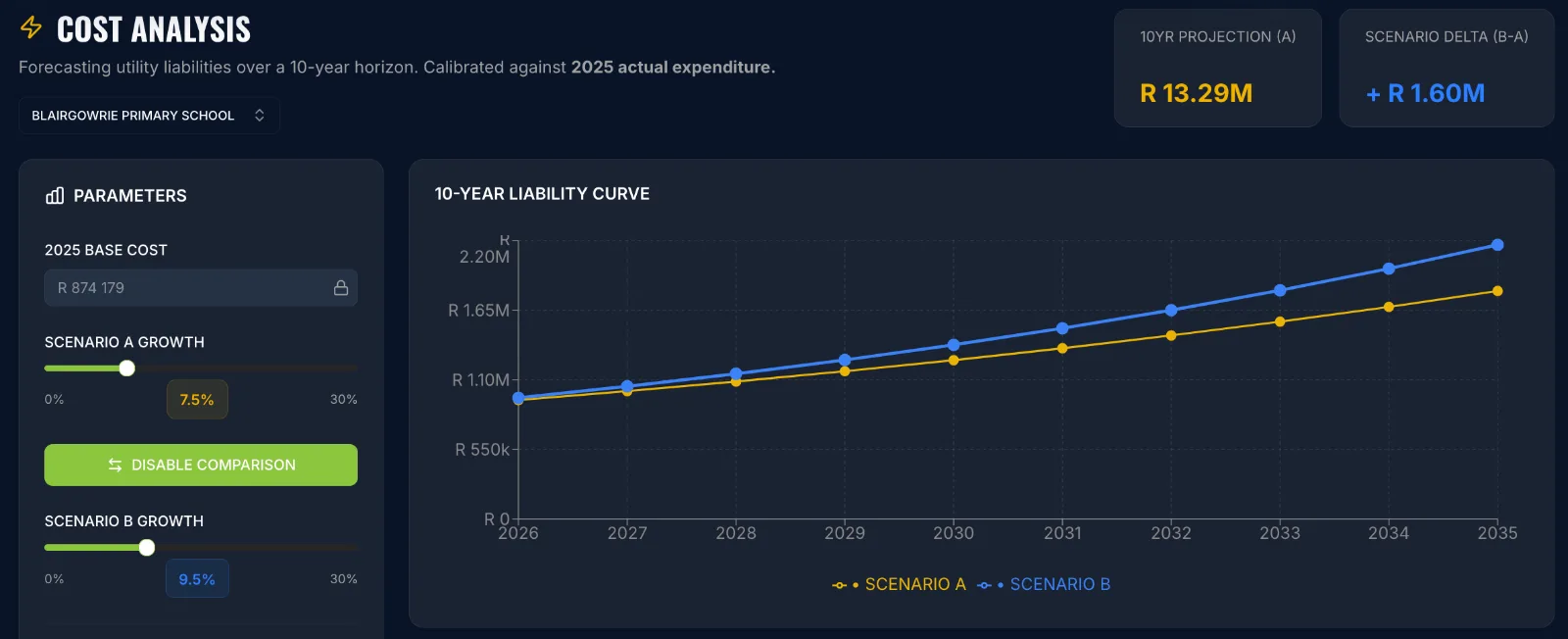
By actively managing utility efficiency today, SGBs can reclaim substantial portions of this capital, redirecting vital funds directly back into further campus infrastructure improvements.
A Phased 1-to-5-Year Optimization Roadmap
Backcasting allows school leadership to define an inspiring long-term target and achieve it through clear, manageable steps:
Phase 1: Establish the Baseline & Achieve Quick Wins (Year 1)
Begin with zero-capital and low-cost operational shifts. Audit monthly municipal invoices, understand after-hours energy loads, implement twice-daily What'sApp water monitoring, audit all lighting & toilet equipment throughout the campus. Understand first phase priority investments. It is appreciated that these are continuous, never-ending and thankless tasks at this initial stage. However, at some stage it will all make sense and there will be a moment that the lights come on.
Phase 2: High-ROI Efficiency Enhancements (Years 1–2)
Upgrade fluorescent lighting to high-efficiency LEDs and roll out your planned maintenance strategy, primarily relating to toilet facilities. Obsessively study consumption and look to understand the daily water consumption readings.
Phase 3: Scalable Renewable Energy Independence (Years 2–5)
With operational waste and daytime baseloads accurately mapped, install a Solar PV system in 2 or maybe 3 planned capital phases essentially freezing electricity costs for the next quarter-century. Systematically replace underground water pipes and toilets fittings to eliminate water waste.
Ensure Early Stakeholder Buy-In
Setting an ambitious target removes limitations and opens the door to genuine innovation within the team. While total perfection must be an ongoing pursuit, eradicating outside school hours water consumption and unnecessary night-time electricity use represents an enormous achievement for any school.
Crucially, one of the most important considerations in this journey is ensuring the involvement of all decision-makers across the school from the very outset.
Securing early buy-in across the Principal, SGB, Bursar, and Estate Manager ensures initial "low-hanging fruit" victories build immediate momentum. When early utility savings demonstrate empirical proof, progress can be contagious, encouraging early doubters to become active champions of the vision.
Join the Suntricity Network. We would love to be part of your journey.
Was this article helpful?